Asking a question that can actually be answered
Whether social-emotional learning works is the wrong question. Whether it was implemented as designed, and for whom it works better, are questions with answers.
- Role
- Researcher
- Context
- Graduate research, UMKC
- Design
- Quantitative, causal-comparative
- Analysis
- Moderated multiple regression
- Status
- Proposal
"Does SEL work" is unanswerable
Districts adopt social-emotional learning programs and then ask whether they worked. The question sounds reasonable and cannot be answered, because two schools running the same program are frequently not running the same program at all. One implements it as designed. The other runs it in the ten minutes before dismissal when there's time.
So the outcome data comes back mixed, and the conclusion drawn is that the program is ineffective, when what actually varied was implementation.
Implementation fidelity is not a footnote in the methods section. It is frequently the entire finding.
The second thing usually missing is any account of context. A program built on one set of cultural assumptions, delivered to students it wasn't designed around, by educators with varying confidence in culturally responsive practice, is not one intervention. It's several.
Full proposal · PDFExploring the relationships between SEL implementation, student outcomes, and culturally responsive teaching practicesThe complete proposal: literature review, research questions, methods, analysis plan, and study diagrams.The design
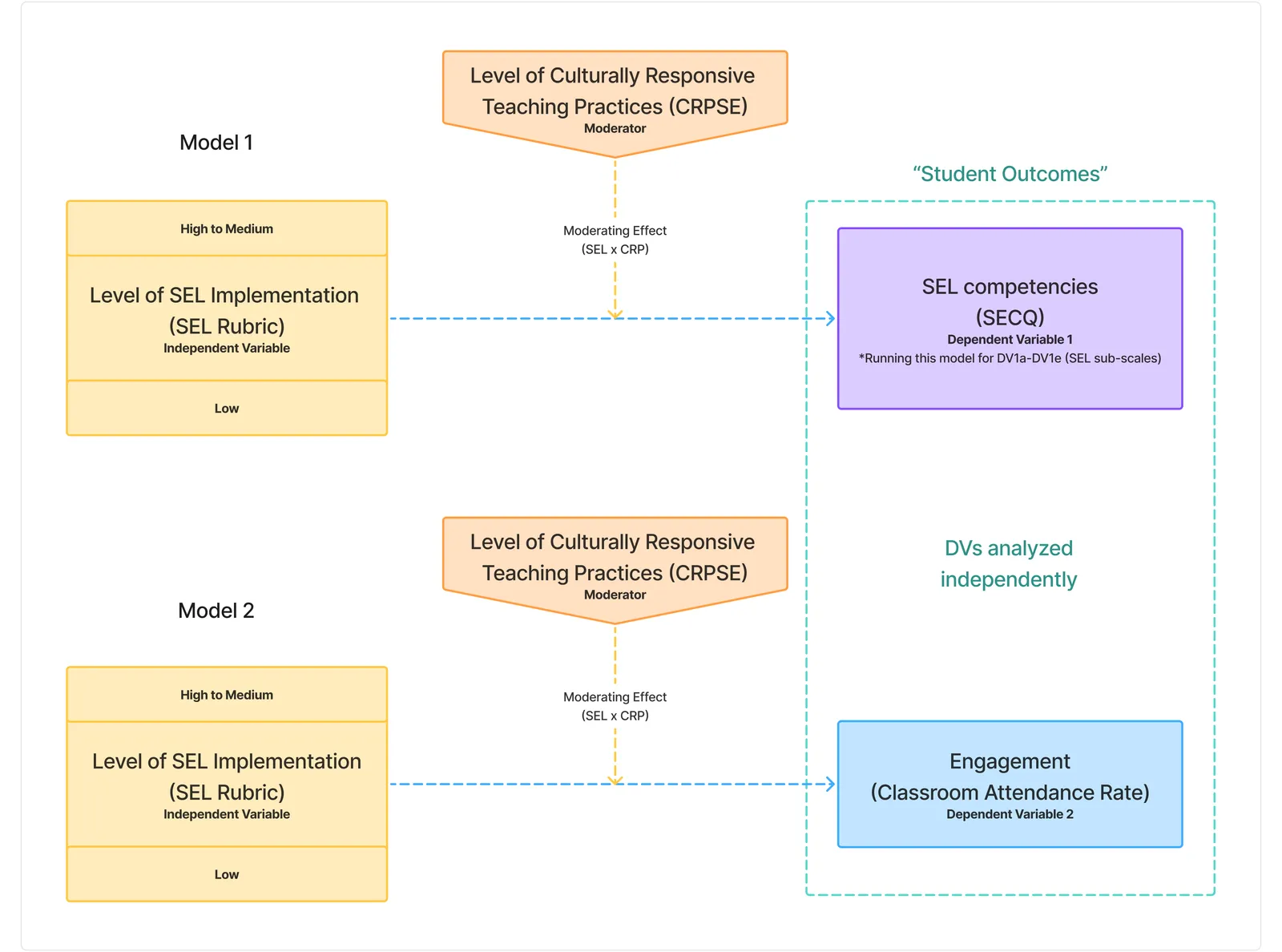
The study asks whether SEL implementation fidelity predicts student social-emotional competency, and whether educators' culturally responsive teaching self-efficacy moderates that relationship. The moderation is the interesting part: not just whether fidelity matters, but whether it matters more in some classrooms than others.
All three constructs are measured with validated instruments rather than invented ones:
- Implementation fidelity, against the CASEL framework
- Culturally responsive teaching self-efficacy, via the CRTSE scale
- Student social-emotional competency, via the SECQ
Analysis is moderated multiple regression. The design is causal-comparative, which is a deliberate tradeoff rather than a shortcut: it works with schools as they already are, without the assignment control a quasi-experimental design would need, and in exchange it gives up the ability to make causal claims. I'd rather name that cost than obscure it.
Who is asking
The proposal includes a positionality statement, and I'd keep it in any version of this work that goes anywhere. I'm a first-generation Mexican American researcher studying whether culturally responsive practice changes what a program does for students. That is not incidental to the question I chose, the moderator I selected, or what I'll notice in the results.
Naming it isn't a disclaimer. It's part of the method, and leaving it out would make the study less rigorous rather than more neutral.
What this has to do with design
This sits in a product design portfolio on purpose. Most design work claims to be evidence-based and means that someone read some articles. Being able to specify constructs, select validated instruments, choose an analysis, name a design tradeoff and its cost, and write an honest limitations section is a different skill, and it's the one that makes the rest of my work checkable.
It's also directly upstream of everything else on this site. The engagement measurement framework exists because I'd already had to think hard about what a construct is, how you'd operationalize it, and what a proxy measure quietly costs you. "Mark as complete" is a fidelity problem wearing a product-metrics costume.
This is a proposal, not a completed study. It has not been run.