A month of design, ten years in production
I designed the student experience for a product that didn't exist yet. It's still shipping, essentially unchanged, and I don't think that's entirely a compliment.
- Role
- Product Design Lead
- Org
- Edmentum
- Product
- Exact Path
- Designed
- Around 2014, in about a month
- Status
- Still in production
One month, K through 12
Edmentum wanted to fill a gap in its product line with an individualized adaptive learning platform. Nothing existed yet. It needed student experiences across K-12, plus educator and administrator views, and the majority of the design had about a month.
The obvious move under that kind of deadline is one interface for everybody. I argued against it and won, which is the decision the rest of this case study rests on.
A first grader and an eighth grader are not the same user, and no amount of schedule pressure makes them one.
We scoped to two bands and built them properly: 3-5 first, then K-2. I flagged at the time that kindergarten had needs distinct enough to eventually deserve its own treatment, which is still true.
The curriculum framework was the problem
For the learning path to adapt, students had to move linearly: a set of lessons, then quizzes, then a final assessment, then either a rerun of the material or a new set. Sound in theory. In practice it's a loop, and loops get old fast when you're seven.
I couldn't change the curriculum framework. It was the constraint, not the brief. So the question became: how do you make a structurally repetitive experience feel worth continuing?
Which is a solved problem, just not in education. Players spend hundreds of hours grinding in MMOs, doing tasks that are repetitive by design, because the surrounding structure gives the repetition somewhere to go. I have a master's in game design, and this is the project where that stopped being a line on my résumé.
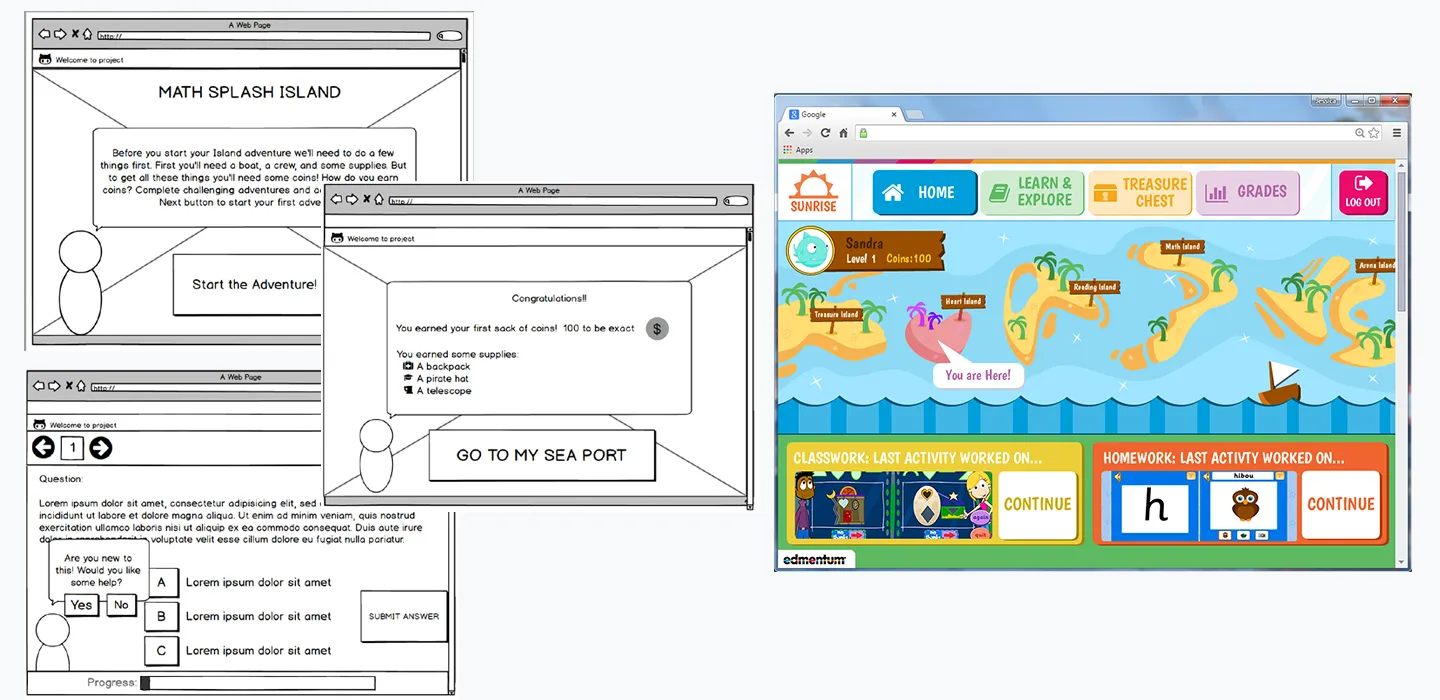
Testing with five-year-olds
I ran competitive analysis across the early-learner category and found the same pattern everywhere: screens packed with activities, characters, and color, all competing for a child's attention at once. More stimulus treated as more engagement.
Then I ran usability testing with actual K-2 students, on tablets and laptops. The clearest finding was physical. Children that age have developing dexterity, and on tablets it showed up as haphazard tapping with mixed success. On laptops, with simple tactile buttons, the same children succeeded far more often. Engagement problems at that age are frequently motor problems wearing a costume.
The second finding mattered more, and it's the one that connects to everything I've worked on since. When young students get stuck, they don't problem-solve. They turn around and ask the teacher. So a confusing student interface doesn't stay a student problem. It converts, directly and immediately, into demand on a teacher's attention during a lesson.
Designing for the classroom means never adding time to a teacher's day. A student experience that fails quietly is not failing quietly at all.
Still there
Exact Path shipped and became Edmentum's flagship. It's still marketed as their primary K-12 personalized learning product, and the student experience I designed is still recognizably the one running today.
Every award through 2020 came while I was still on the team, and they have kept coming since. The design being judged in those years is the one I shipped.
- Tech & Learning Best of Show at ISTE, 2018 and again in 2019
- Best of Show at ISTE and the SIIA CODiE Award for Best Learning Capacity Building Solution, both 2020
- Best of Show at ISTELive in 2022, 2023, and 2024
- EdTech Awards, Best Adaptive Technology Solution, 2023
- EdTech Cool Tool winner plus three finalist categories, 2024
- EdTech Breakthrough Award, 2025
Those are product awards rather than design awards, which is the only kind edtech really hands out. But a category award in the first year after launch is a judgment on the thing users actually touch.
In productionExact Path, todayStill Edmentum's flagship adaptive learning product. The student experience underneath it is the one designed in that month.Ten years is a long time not to look
I'm proud of how much of it held. Designing something in a month that survives a decade of platform changes and roadmap cycles means the underlying model was right, and I'd defend the grade-band decision again tomorrow.
But a student experience going ten years without a serious revisit isn't a testament to my design. It's a fact about where student experience sits on the priority list. In that same decade the industry shipped an enormous amount of teacher tooling, admin reporting, and analytics. The screen the child actually looks at tends to get built once and then inherited.
This is the thing I've spent the years since arguing about, and it's why the argument isn't abstract for me. I built one of the examples.
What I'd change
Kindergarten still deserves its own experience, and I said so at the time. The gamified layer solved the repetition problem at the surface without addressing the pattern that caused it, which was the right call under that deadline and the wrong one to leave in place for a decade. And I had no way to measure whether any of it was working beyond completion rates, which is the gap that eventually turned into an engagement measurement framework years later.