The gap isn't information
Teenagers live inside digital tools all day and still can't see a path from that to a career. More information was never going to fix it.
- Role
- Program design, research, build
- Context
- Graduate coursework, UMKC
- Population
- High school students, KCPS
- Grounding
- SCCT, Krumboltz, Super
- Status
- Built and live
Fluency is not the same as a path
Students spend hours in gaming, streaming, social platforms, and content creation. That fluency is real. What almost none of them have is any sense of how it connects to work that exists, or how a person like them would get there.
The standard response is to give them more information. Career sites, interest inventories, lists of jobs with median salaries. That treats the gap as informational, and I don't think it is. A student who has never seen someone from their school do a thing does not lack a description of the thing. They lack any reason to believe it applies to them.
The gap isn't information. It's self-efficacy, which means the intervention has to be built for confidence rather than for browsing.
The second half of the problem is on the adult side. Educators are expected to guide students toward emerging tech pathways, and research consistently finds they feel underprepared to do it. That's not a knowledge gap you can close with a resource library either.
One school, in detail
I interviewed a digital learning specialist at Paseo Academy, a Kansas City Public Schools arts high school of roughly 670 students and 60 teachers, who runs their digital media program and their esports team. The esports program is certified through the Missouri Scholastic Esports Federation, and it exposes students to real roles: game design, broadcasting, production, IT networking, coaching.
What came out of that conversation reframed the design:
- Only a small share of students reach these opportunities, and the limiting factor isteacher confidence, not student appetite. Educators were unsure when or how to use emerging tools, so exposure depended on which adult a student happened to get.
- There was no consistent way to assess students' digital career interests at all. Career exploration happened when an individual teacher decided to run something.
- The result is uneven by design. Two students in the same building get completely different exposure based on staffing.
That finding is what produced the two-sided structure. A student-only product would have been rationed by exactly the constraint the research surfaced.
Two halves, one intervention
Teacher Toolkit
Short, low-preparation activities that let an educator introduce digital career concepts without needing technical expertise first: lesson starters, discussion prompts, career videos, reflection tools, activity cards. The goal is not to train teachers. It's to lower the confidence threshold enough that the conversation happens at all.
Student Journeys
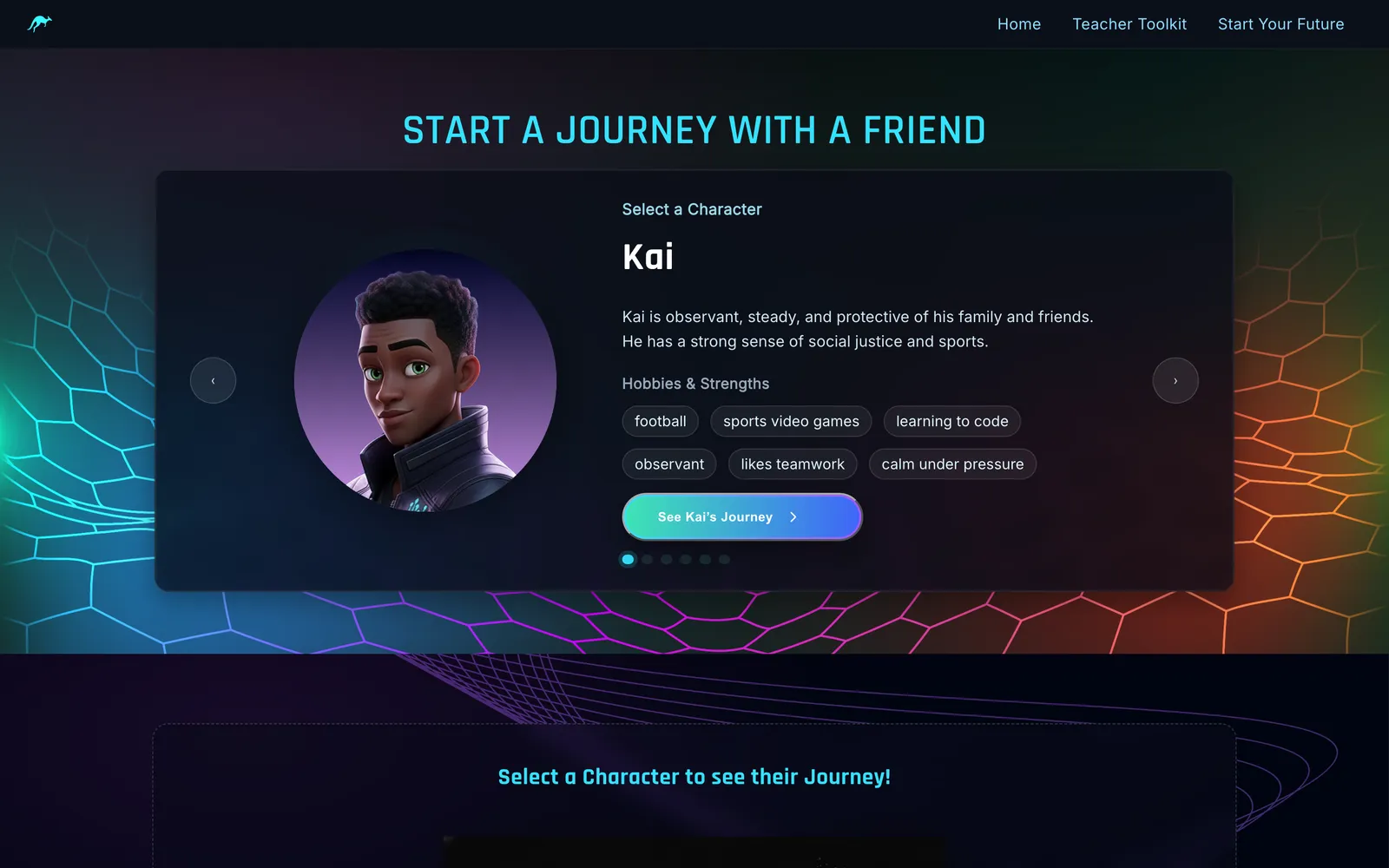
Students pick a character guide and travel a career path with them, exploring interest-based content, identifying the skills involved, and reflecting on how their own strengths connect. Each completed journey earns a badge. Finishing all six earns a printed certificate.
Where each design decision came from
Every element above traces to a specific mechanism in career development theory. This is the part I'd want anyone evaluating my work to read, because it's the difference between research as decoration and research doing the deciding.
| Theory | Mechanism | What it produced |
|---|---|---|
| SCCT | Self-efficacy is built through mastery experiences, not persuasion | Journeys broken into small, completable steps so a student accumulates evidence of their own capability |
| SCCT | Vicarious learning: seeing someone like you do the thing | Character guides who travel the path alongside the student instead of a neutral catalog of roles |
| SCCT | Outcome expectations strengthen with recognition and encouragement | Badges per journey, a certificate at six, and toolkit prompts that put a teacher in the encouraging role |
| Krumboltz | Happenstance: curiosity and experimentation matter more than planning | Exploration that doesn't require knowing what you want first, and no wrong entry point |
| Super | Self-concept develops across life roles and stages | Reflective prompts asking students to connect interests and values to a forming identity, not to pick a job |
Read down the middle column and the program is basically re-derivable. That's the test I hold my own work to now: if you removed the theory, would the design still be the same? Here it wouldn't be.
How I'd know if it worked
Pre and post assessment on both sides. Teachers on comfort with digital career content, familiarity with pathways, and confidence supporting exploration. Students on awareness of digital careers, understanding of their own strengths, and confidence connecting the two. Qualitative reflections from both. Longer term, follow-up on whether participation in CTE and technology programs shifts at all.
Note what's being measured: confidence, not knowledge. If the theory of change is self-efficacy, a knowledge test would tell you nothing about whether the intervention did its job.
What this is and isn't
This was graduate coursework, and it remains conceptual. The activities and pathways have not been reviewed by educators or curriculum specialists beyond that one interview, and it has never been run with students. I said so in the paper and I'll say it here.
What went past the assignment is that I built it. The paper called for a proposal, and proposals are easy to write and impossible to evaluate. So there's a working site instead.
Live sitestartyourfuture.orgThe program as built. Teacher toolkit, six student journeys, character guides, badges.Two adults, unprompted, each spent close to an hour in it. That is not an efficacy result and I'm not presenting it as one. But they were adults with no assignment, no teacher, and no badge that meant anything to them, and the journeys held them anyway. Given the whole design is about sustaining attention without extrinsic pressure, it's the one signal I have and I'll take it.
The paper was co-authored for the course. The program design, the build, and the site are mine.