A system that outlived its author
Designers had no way to see their own growth except through a manager's opinion of it. So I built the instrument, and then HR built theirs from mine.
- Role
- Design and facilitation
- Org
- Discovery Education
- Started
- March 2025
- Outcome
- Adopted beyond design
Growth measured by vibes
Before this existed, a designer at Discovery Education had no structured way to assess their own skill level. Career conversations ran on qualitative feedback and whatever their manager happened to notice. HR had goal-setting initiatives, but they were general enough that they couldn't measure design skill progression at all.
Managers had the mirror-image problem. Asked to guide someone's professional development beyond "ship the roadmap" or "be more senior," they had nothing concrete to point at. And because HR had no design-specific framework, advancement decisions rested on impressions, which is exactly the condition under which advancement stops being equitable.
If nobody can describe what better looks like, then better is whatever the person in the room says it is.
Starting from someone else's work
I didn't invent a competency model from nothing. There was a well-regarded public framework for design teams already, and starting there meant the arguments could be about what was missing rather than about whether a framework was needed.
Two things were missing for how our team actually worked:
- Influence. The soft skills and leadership behaviors that determine whether a designer's work lands on a cross-functional product team. This was inspired by an unfinished framework from a former manager, which deserves the credit.
- Analysis. Synthesizing research and information into a point of view, which is arguably the core designer skill and was nowhere in the original.
The original was also rigid, which was the third gap. A researcher and a visual systems specialist should not be measured on an identical column set, so the model needed to flex by specialization.
I socialized it with managers and senior designers first, then introduced it in a Design Jam, then took it deeper in the K-12 team meeting. The questions that came back were mostly about seniority mapping and how it would reconcile with corporate HR systems, which told me something important: people were treating it as real before it was official.
A document nobody touches is a document nobody uses
Reading through it, I could see the gap. It was a reference table. Designers were already asking how to track themselves against it, and my read was that they'd want to interact with the framework rather than consult it. A static rubric gets looked at once.
So I designed a worksheet set: self-assessment, structured space to cite real examples of your own work as evidence, and manager feedback in the same artifact. Then radial visualizations, so a designer could see the shape of their skills instead of reading a grid. The picture is what makes it land. You can see your own asymmetry immediately.
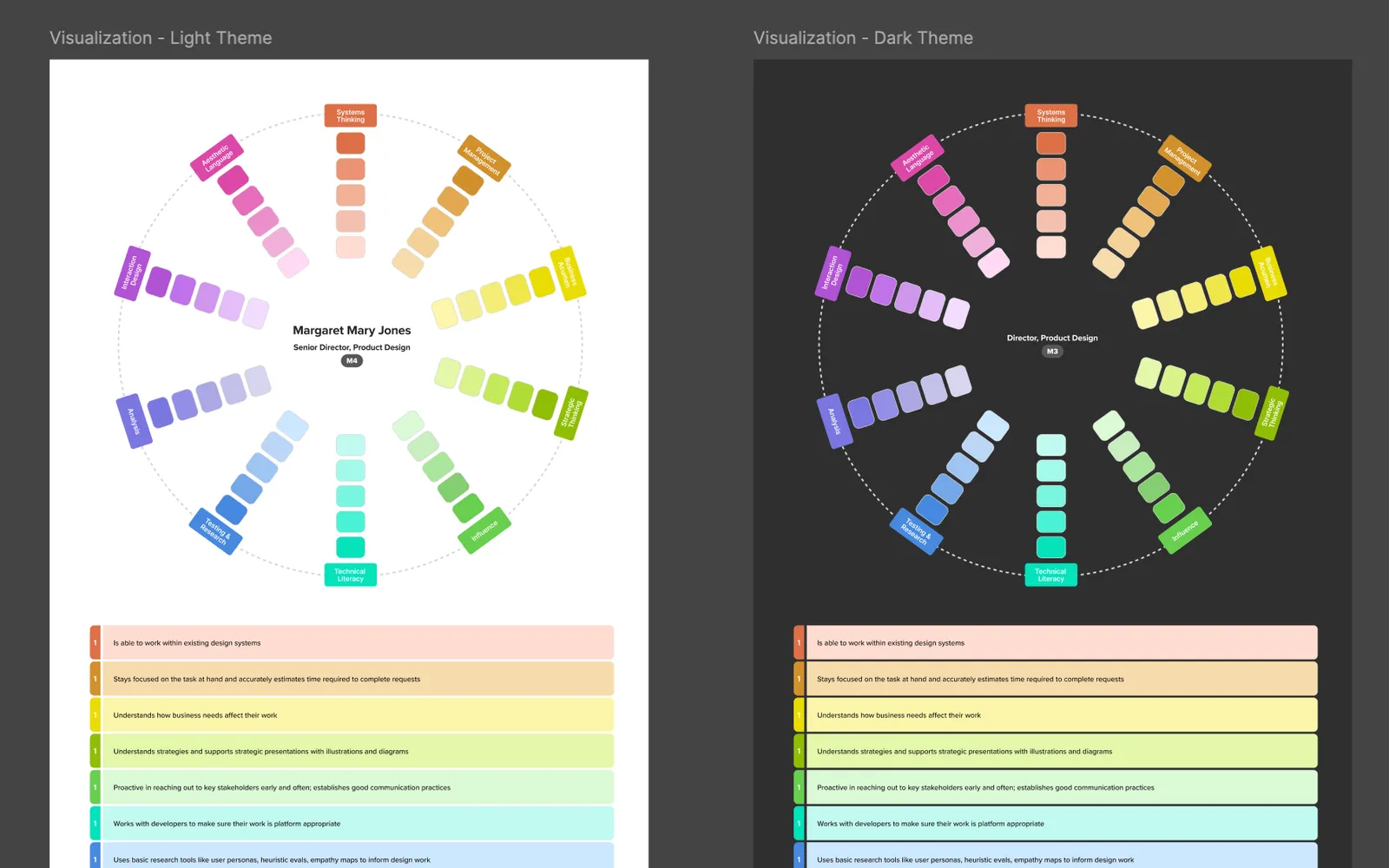
This is the same conviction that runs through everything else on this site. Engagement is not a nice-to-have on top of a system. It's the difference between a system that gets used and one that gets archived.
Three passes
First, the framework itself: refining the wording at every category and competency intersection to match how our design org actually talked, then piloting it with a small group of designers during quarterly reviews.
Second, usability. The radial charts and the worksheets came out of this round, along with a dark mode, plus layout and structure fixes that came directly from watching people try to fill them in.
Third, specialization, which is still in progress. The goal is swappable competencies so a research-focused designer can trade aesthetic criteria for deeper research ones without leaving the framework.
The most useful feedback came from use, not from review. People agreed with the framework in the abstract and only discovered what was ambiguous when they had to score themselves against it.
It left the design team
HR borrowed elements of this framework to build their own. A tool made for one design org became the basis for how the company thought about growth more broadly. I had no authority over HR and no mandate to influence them. The framework did that on its own, because it was more concrete than what existed.
It's in active use for:
- Performance reviews
- Goal setting and career development planning
- Promotion discussions
The outcome I think about most, though, is a single case. A designer on our team participating in an on-the-job training program for professionals on a work visa needed formal documentation of her skills and development plan. There was no standardized way to produce that. The framework became it.
A competency rubric is an abstraction until the day it's the only document that can show what someone is capable of.
Designers also changed their plans because of it. One realized they wanted to grow in strategic thinking and set a goal against it. Others found their self-assessment didn't match the criteria they'd assumed they met, and adjusted toward things they'd been overlooking. That gap between self-perception and definition is the whole point.
What isn't finished
Formal validation with HR so it can carry weight in promotion decisions is still in progress. That's the difference between a tool people find useful and one that functions as objective evidence, which is what would make advancement genuinely more transparent.
Specialization tracks aren't built. Wording still needs refinement, and the bi-annual team and culture survey now includes questions on career pathing so the framework keeps getting revised against what people actually report.
The thing I'd tell anyone building one of these: we approached it like a design problem, prototype and test and refine, and that was right. But no amount of review surfaced what real usage surfaced in a week.